


The short version
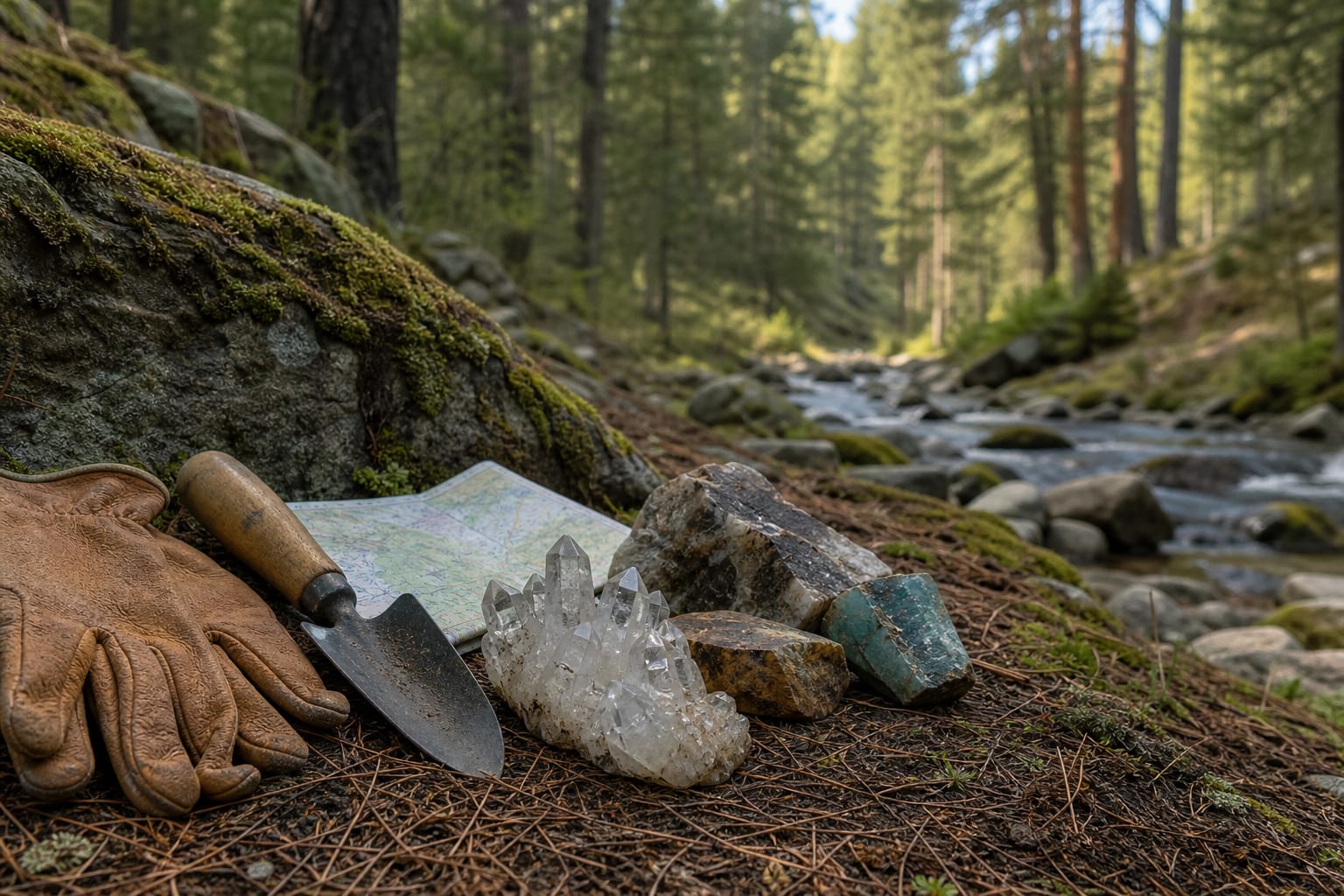
The U.S. Forest Service manages about 193 million acres of public land, most of it open, on a casual basis, to rockhounding. The general rule is the same as on BLM ground: small amounts, hand tools, personal use, no vertebrate fossils, no archaeological items, no active mining claims. The catch is that USFS sets rules at the forest and ranger district level, which means details differ from one valley to the next.
Default casual-collecting rules
When a forest does not post specific rockhounding rules, the default is the standard USFS recreational mineral collection policy:
- Collect reasonable amounts of rocks, minerals, and invertebrate fossils for personal use.
- Use hand tools only. No power equipment, no explosives, no earth-moving.
- No collecting in designated wilderness, research natural areas, or other specially-managed zones.
- No collecting on active mining claims.
- No vertebrate fossils; no archaeological items.
- No commercial sale.
"Reasonable amounts" is intentionally vague. Most rangers interpret it as similar to BLM's 25-pounds-per-day-plus-one-piece rule. If a ranger district publishes a written limit, that limit applies.
Forest by forest, things vary
A few examples where the local rules deviate from the default:
- Hansen Creek (Mount Baker–Snoqualmie NF, Washington): Famous for quartz crystals and amethyst. Casual collecting is allowed; the area has been quietly busy for decades.
- Emerald Creek (Idaho Panhandle NFs): Star-garnet area run as a permit dig. Day fee, posted limits, set season.
- Crystal Park (Beaverhead-Deerlodge NF, Montana): Recreation site specifically signed for crystal digging.
- Ouachita National Forest (Arkansas, Oklahoma): Open to quartz crystal collection on a casual basis. Pay-to-dig mines on private inholdings are separate.
- Tonto NF, Coronado NF, Coconino NF (Arizona): Generally open. Some areas inside or adjacent to wilderness are off-limits.
Wilderness is the hard line
A National Forest may have hundreds of thousands of acres of wilderness inside it. Once you cross a wilderness boundary, federal law (the Wilderness Act of 1964) prohibits collecting any natural object, including rocks. Wilderness boundaries are usually marked but not always; check a topographic map or use the federal-land overlay in the RockHoundR app.
Gold panning specifically
Recreational gold panning with a non-motorized pan and hand tools (digging stick, small shovel) is allowed on most USFS land that is not closed to mineral entry. Once you add a sluice, suction dredge, or motorized equipment, you are in the realm of locatable minerals, which means a mining claim and a written plan of operations.
Some districts require a free recreational mineral collection permit specifically for gold panning. The permit is administrative. They want to know who is in the woods. It does not cost anything but is required.
How to find the local rules
- Identify the National Forest and ranger district that covers your spot.
- Visit the forest's website and search for "recreational mineral collection" or "rockhounding".
- If nothing turns up, call the ranger district. Most rangers are friendly and will tell you the rule.
- Cross-check for wilderness, special-use, and mining claim status.
Where to start
Some of the most-collected USFS rockhounding states:
- Idaho, Bruneau jasper, Owyhee, Emerald Creek garnet
- Washington, Hansen Creek, Walker Valley
- Montana, Crystal Park, Yogo sapphire country
- Arkansas, Ouachita NF quartz
- Oregon, Mt. Hood, Willamette, Deschutes NFs
Frequently asked questions
Can you rockhound in a National Forest?+
Do I need a permit to collect on National Forest land?+
Is gold panning allowed in National Forests?+
What is the difference between BLM and USFS rockhounding rules?+
Sources
- USDA Forest Service Manual 2800 (Minerals and Geology)
- 36 CFR 261.9 (prohibited acts on National Forest System lands)
- USFS regional rockhounding brochures (vary by region)
- Paleontological Resources Preservation Act, 16 U.S.C. §§ 470aaa