


The honest minimum
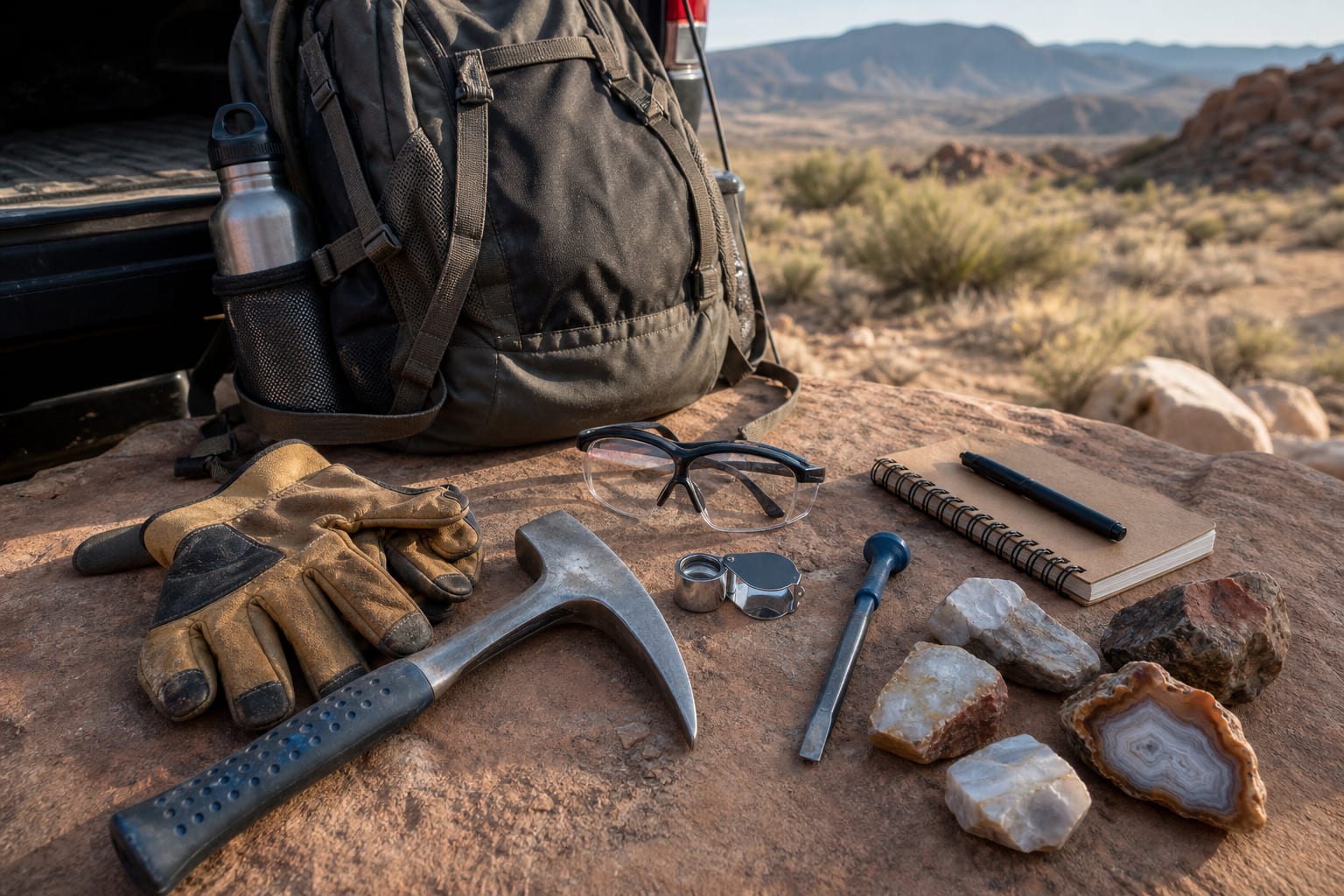
You can rockhound with very little. A pair of leather gloves, safety glasses, and a 22-ounce rock pick is enough for most surface picking on agate, jasper, and quartz ground. Beginners often overspend on gear and underspend on the part that matters: knowing where to go.
Below is the gear that earns its weight, in roughly the order I'd buy it.
1. The rock pick
A geologist's pick (also called a rock hammer or estwing) is the single most important tool. It is a one-piece forged-steel hammer with a flat striking face on one end and either a chisel point or a pick point on the other.
- Pick end vs. chisel end. A pick point is better for prying material out of dirt and gravel. A chisel point is better for splitting layered rock. Most rockhounds prefer a pick.
- Weight. 22 ounces (about 620 g) is the standard. Anything heavier turns into a wrist injury after a long day. A 16-ounce model is plenty for kids or surface picking.
- One-piece construction. Cheap two-piece hammers come apart. A one-piece forged pick lasts decades.
Brand-wise, Estwing is the field standard. Other forged options work; avoid the unbranded big-box-store hammer with a wood handle.
2. Safety glasses
The number one rockhounding injury is a chip in the eye. Hard-on-hard impacts (steel on quartz) launch fragments at high speed. Cheap polycarbonate ANSI Z87-rated safety glasses ($10–$15) are non-negotiable. Wear them every time the hammer comes out.
3. Leather gloves
Cuts come from broken glassy material (obsidian, fresh chalcedony) and abrasion from carrying loaded packs. A sturdy pair of leather work gloves protects your hands without losing dexterity. Mechanic-style gloves with synthetic palms are a poor substitute, they tear quickly on rock.
4. Boots and field clothes
Lightweight hiking boots with good ankle support and a stiff sole. Most spots involve loose talus, cobble fields, or wet streambeds. Avoid sneakers; a turned ankle ten miles from the trailhead is a long walk out.
Long pants and long sleeves help against thorn brush and sunburn. A wide-brim hat is worth every penny in summer.
5. A small chisel set
For splitting harder rock or extracting embedded crystals, a set of cold chisels (1/2-inch, 3/4-inch, and 1-inch) and a 3-pound crack hammer is the next level of kit. The chisels do the precision work; the crack hammer drives them.
Hold the chisel with a leather glove or use a chisel guard. Strike with the crack hammer, not the rock pick, the pick's narrow face will glance off and find your knuckles.
6. Loupe (10x–14x)
A jeweler's loupe is small enough to clip to a belt loop and lets you check translucence, banding, mineral inclusions, and microcrystal structure on a piece you're considering. The Belomo 10x triplet is a longtime field favorite. A cheaper $10 loupe works fine to start.
7. Day pack
Rocks are heavy. A day pack with a hip belt and a rugged bottom (you'll be loading ten to twenty pounds of stone in there) makes the walk back tolerable. Old climbing packs work great because they're built for similar loads. Cinch straps prevent the load from shifting.
Two cheap tricks: line the inside with a contractor-grade trash bag (so dirt and gravel don't grind into your pack), and pre-pack a couple of small zip-top bags so individual finds don't grind against each other on the walk out.
8. UV light (optional but fun)
Many minerals fluoresce under UV. A short-wave UV flashlight (around 254 nm) reveals fluorite, calcite, willemite, and the famous sodalite "yooperlite" stones on Lake Superior shores. Long-wave (365 nm) is cheaper and shows different minerals. Both are night-only tools but are extremely satisfying once you see your first glowing rock.
9. GPS or app
A phone-based GPS app is enough for most rockhounding trips. The right app shows public-land overlays (BLM, USFS, NPS) so you know where you can legally collect. The RockHoundR app does this plus weather, geology, and saved spots in one place.
Carry a paper map as backup if you're going somewhere remote. Cell service is unreliable in most rockhounding country.
10. The little things
- Spritz bottle of water. Wetting a rough piece often reveals translucence and color, useful in the field.
- Small pry bar or screwdriver. For digging out partly-buried specimens.
- Tweezers. For micro-mineral collecting.
- Newspaper or paper towels. To wrap fragile pieces.
- Notebook + Sharpie. Mark where each find came from. Locality is the difference between "specimen" and "rock."
- First-aid kit. Especially blister and band-aid supplies.
- Plenty of water. Two liters minimum in the desert. Heat is the most common rockhounding emergency.
What to skip
- A "rockhounding tool kit" sold as a bundle. Bundles are usually cheaper components packaged at a markup. Buy good components separately.
- Power tools. Casual collecting on BLM and USFS land is hand tools only. Power tools require a permit or claim.
- A metal detector unless you're specifically going gold prospecting or meteorite hunting.
- An expensive geology hammer for your first trip. A $35 entry-level rock pick will outlast most beginner careers.