


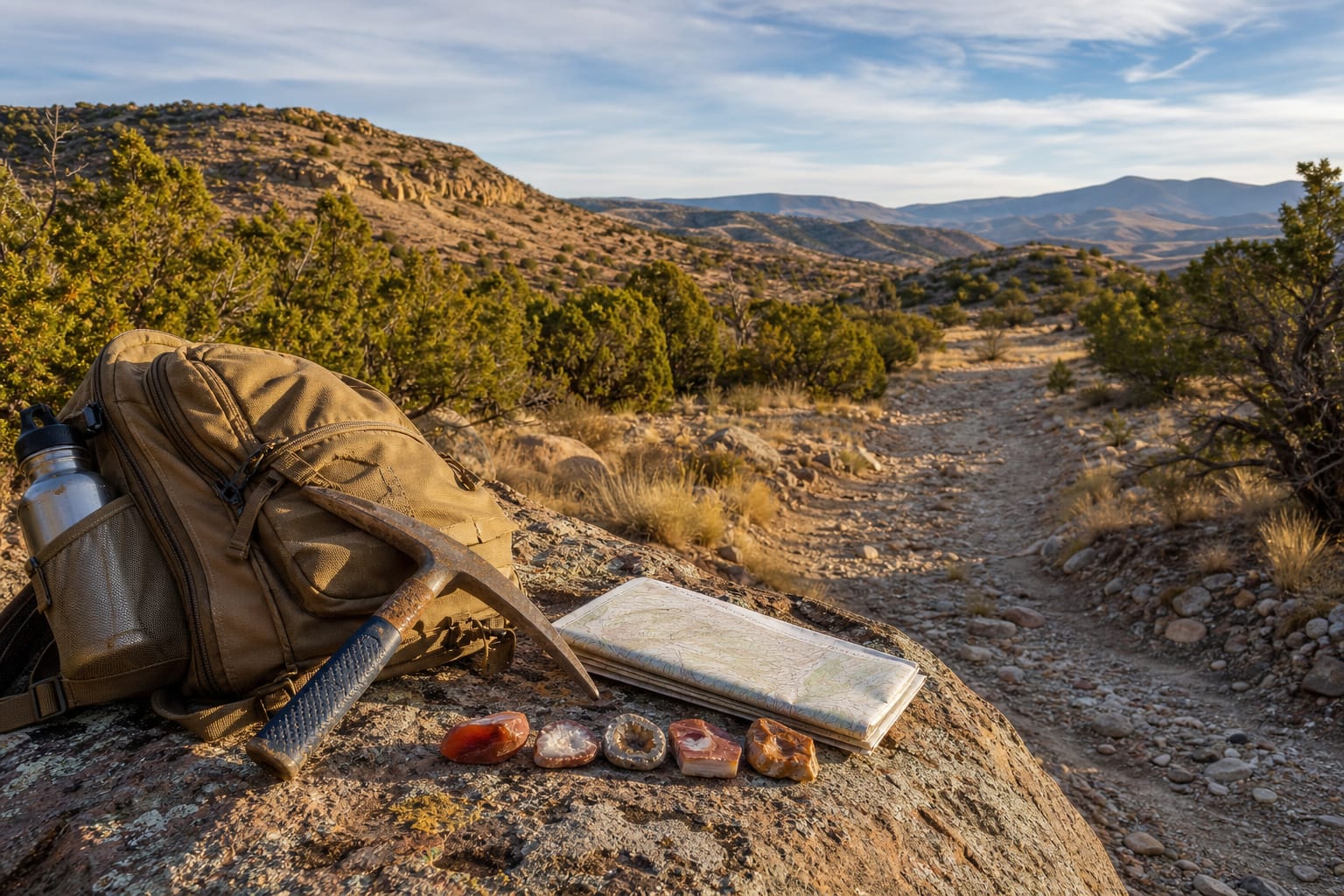
What "without a permit" means
For rockhounds, "without a permit" really means casual collecting: a small amount of rocks and minerals, taken by hand or with hand tools, for personal use, off public ground that is open to recreational mineral collection. No paperwork, no fee, no calling ahead.
The U.S. has more public land that meets that definition than almost any other country in the world. Knowing where it lives (and where it doesn't) saves you a lot of trouble.
The big buckets
Bureau of Land Management (BLM)
The biggest single source of permit-free rockhounding in the country. About 245 million acres, mostly in the West. Casual collection is allowed on most of it, with a 25 lb/day, 250 lb/year cap. See BLM Rockhounding Rules for the details.
U.S. Forest Service (USFS)
About 193 million acres of National Forest land. Casual collection is allowed on most of it, with rules set forest-by-forest. See National Forest Rockhounding Rules.
Specific signed rockhound areas
Some federal areas are specifically designated for rockhounding. They're usually a generous experience: mapped, signed, sometimes graded for vehicle access:
- Round Mountain Rockhound Area (BLM, Arizona): Apache tears (obsidian)
- Glass Buttes (BLM, Oregon): obsidian in many varieties
- Topaz Mountain (BLM, Utah): sherry topaz
- Rockhound State Park (NM State Parks, New Mexico), encourages collecting up to 15 lb per visitor
- Crystal Park (Beaverhead-Deerlodge NF, Montana), quartz crystals
- Hansen Creek (Mt. Baker-Snoqualmie NF, Washington), quartz, amethyst
State exceptions
Most state parks prohibit collecting. The two big exceptions are Crater of Diamonds State Park in Arkansas (where you keep what you find, for a day fee) and Rockhound State Park in New Mexico (which has a small daily take).
The states with the most permit-free public ground
By share of public land per square mile, the most rockhound-friendly states are:
- Nevada, about 80% public, mostly BLM
- Utah, large BLM and USFS shares
- Idaho, heavy USFS in the Panhandle and central ranges
- Oregon, strong BLM in the southeast, USFS through the Cascades
- Wyoming, sweeping BLM in the central and western parts
- Arizona, broad BLM in the western and southern half
- New Mexico, good BLM coverage plus the state park exception
Where you cannot collect, even casually
- National Parks. Zero collecting. Period.
- National Monuments (most of them). Some monuments allow casual rockhounding; many do not. Read the proclamation.
- Designated Wilderness (anywhere, BLM, USFS, NPS).
- Tribal land. Always requires permission from the tribal government.
- Active mining claims. Even on otherwise-open BLM land.
- National Wildlife Refuges (most). Some allow limited collecting under refuge-specific rules.
- State lands in many states (varies, check before collecting).
- Private land without explicit landowner permission.
Limits to remember
"No permit" does not mean no rules. The casual-collecting limits still apply:
- Reasonable amounts (BLM: 25 lb/day + one piece, 250 lb/year).
- Hand tools only.
- No vertebrate fossils, no archaeological items, no cave material.
- No commercial sale.