


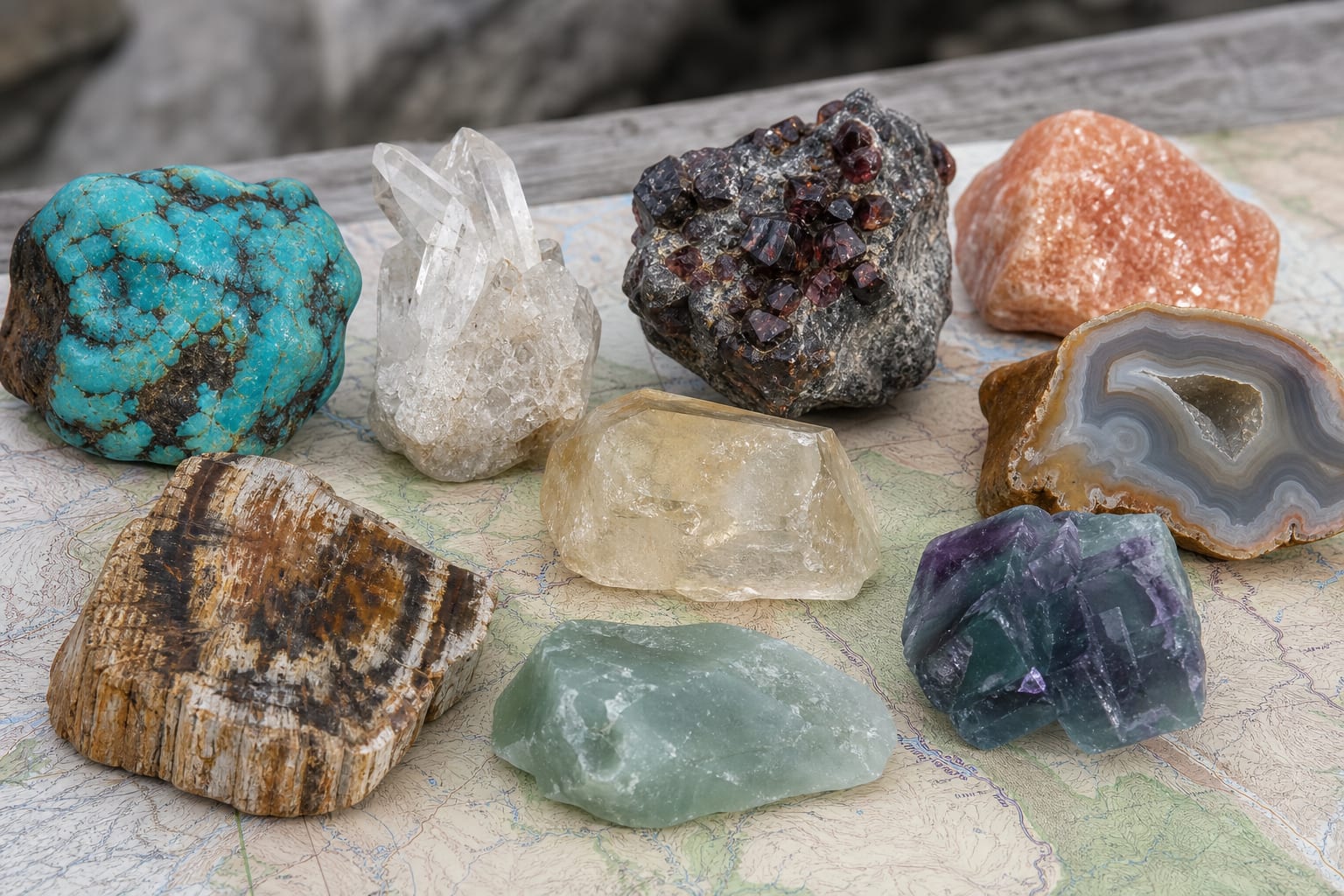
Why states pick a gemstone
Most U.S. states have officially designated a state gemstone, rock, mineral, or fossil, usually as a tribute to local geology, mining heritage, or material that has been collected on that ground for generations. For rockhounds, the official list is a useful tour guide: if a state went out of its way to honor a stone, there is almost always public ground nearby where you can hunt it.
The full table
Click a state to see the rockhounding spots in our database. Click a mineral to see other states that produce it.
Stand-out picks
The big-ticket gems
A handful of state gemstones are world-class material that rockhounds chase from across the country. North Carolina's emerald, Montana's sapphire, Oregon's sunstone, and Nevada's black fire opal all anchor active collecting scenes with both fee-dig and public ground options.
The accessible classics
Some state gems are easy to legally collect on public land if you know where to look. Lake Superior agate on Minnesota beaches, Utah's sherry topaz at Topaz Mountain, Arkansas's quartz crystals in the Ouachita National Forest, and Idaho's star garnet at Emerald Creek (with a permit) are all famously productive.
The unique and unusual
Several states honor materials you cannot find anywhere else. Maryland's Patuxent River Stone, Florida's agatized coral, Oklahoma's rose rock (a barite-cluster crystal habit), and Iowa's Keokuk geodes are all locality-specific.
How to use this list
The state gemstone is a great starting point, not a complete map. A state may have far better collecting for materials that aren't its official gem (Wyoming's official gem is jade, but its agate fields are arguably better-known). Use the list to seed a trip, then dig deeper on the linked state and mineral pages for actual spot lists.