
Turquoise vs Howlite: how to tell them apart
Quick answer
Most cheap blue turquoise is actually dyed howlite. Real turquoise is naturally blue-green and harder (Mohs 5 to 6), while howlite is naturally white, softer (Mohs 3.5), and takes dye easily. Look for dye pooling in the cracks, an acetone swab that lifts blue color, and a surface a steel pin scratches readily.
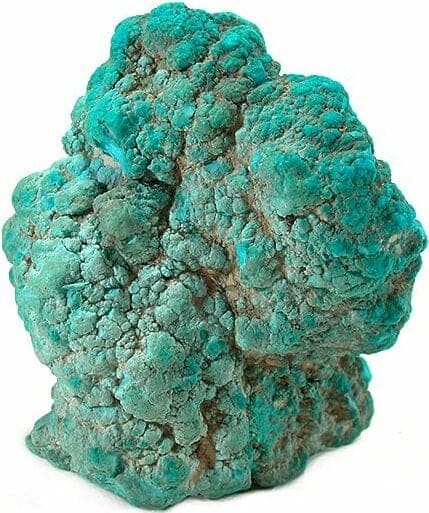
Turquoise
Full turquoise guide →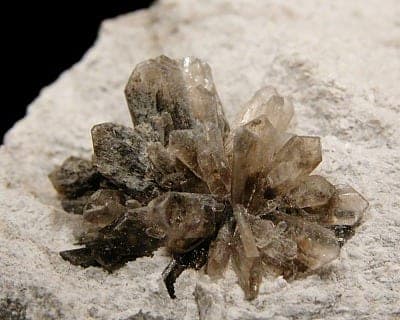
Howlite
Full howlite guide →Howlite is the most common stand-in for turquoise because it is white with grey to black webbing that mimics turquoise matrix, and it takes dye eagerly. Sold as white buffalo turquoise, white turquoise, or simply dyed blue, it floods the cheap bead market. Real turquoise is a copper aluminum phosphate colored blue-green by copper; howlite is a borate that is naturally white. The two part ways on hardness, on how the color sits in the stone, and on price.
What is the difference between Turquoise and Howlite?
Natural color
- Turquoise
- Blue to blue-green throughout, colored by copper.
- Howlite
- Naturally white or grey. Any blue is added dye.
Hardness
- Turquoise
- Mohs 5 to 6. Resists a steel knife in better material.
- Howlite
- Mohs about 3.5. A pin or knife scratches it easily.
How color sits
- Turquoise
- Even color through the body, matrix is host rock.
- Howlite
- Dye pools darker in cracks and around the webbing.
Matrix pattern
- Turquoise
- Irregular brown, black, or golden host-rock veining.
- Howlite
- Fine, fairly even grey to black natural webbing.
Turquoise vs Howlite: properties compared
Highlighted rows are where Turquoise and Howlite differ. The badge marks the most reliable at-a-glance separator. Property data from the RockHoundR mineral database.
| Property | Turquoise | Howlite |
|---|---|---|
| Type | Mineral | Mineral |
| Mohs hardness(differs)Best field test | 5-6Harder | 3.5 |
| Streak(differs) | White to Pale Greenish Blue | White |
| Transparency(differs) | Opaque | Translucent in Thin Fragments |
| Luster(differs) | Vitreous in Crystals; Dull to Waxy If Massive | Subvitreous, Glimmering |
| Cleavage(differs) | Perfect On {001}; Good On {010} | None |
| Crystal system(differs) | Triclinic | Monoclinic |
| Crystal habit(differs) | Massive, Cryptocrystalline, Botryoidal, Crusts | Earthy, Massive, Nodular |
| Fluorescence | Not recorded | Bright Sky Blue Under LW UV |
| Chemical formula(differs) | CuAl₆(PO₄)₄(OH)₈·4H₂O | Ca₂B₅SiO₉(OH)₅ |
Why are Turquoise and Howlite confused?
Dyed howlite copies the look of turquoise convincingly: the same sky-blue body and the same dark spiderweb matrix. Strung as beads or set in silver, it fools shoppers routinely, which is exactly why it is sold that way.
How to tell Turquoise from Howlite
Ordered from the most reliable field test to the least. Start at the top.
- 1
Acetone or nail-polish-remover swab
ReliableRub an inconspicuous spot with a cotton swab dipped in acetone. Dyed howlite often releases blue onto the swab. Natural, untreated turquoise will not give up color. Note that stabilized turquoise can also resist, so pair this with a hardness check.
- 2
Hardness scratch test
ReliableOn an inconspicuous edge, try a steel knife or a hardened steel pin. Howlite at Mohs 3.5 scratches readily; good turquoise at Mohs 5 to 6 resists. Be gentle, since this is a destructive test.
- 3
Read the color in the cracks
UsefulLook at the stone under magnification. Dye concentrates as darker blue pooling along fractures and at the edges of the matrix. Natural turquoise color is more uniform and does not darken specifically inside cracks.
- 4
Consider the price and uniformity
SupportingLong strands of flawless, identical bright-blue beads for a few dollars are almost always dyed howlite or reconstituted material. Natural turquoise varies bead to bead and is rarely that cheap.
Turquoise or Howlite: which is more valuable?
Natural, untreated turquoise from known mines is far more valuable than howlite, and value climbs with even color and desirable matrix. Howlite itself is inexpensive, and dyed howlite has only decorative value. Honest sellers disclose dye and stabilization; vague labels like turquoise-colored are a warning sign.
Where to find each
Bottom line
If a pin scratches it easily, the blue lifts onto an acetone swab, or color pools in the cracks, it is dyed howlite. Even color, real hardness, and irregular host-rock matrix point to turquoise.
Common questions
How can I tell if turquoise is real or dyed howlite?+
Is white buffalo turquoise real turquoise?+
Does the acetone test always work?+
Why is howlite used to fake turquoise?+
References
Identify your find in the field
RockHoundR maps rockhounding spots, shows land access, and lets you log and label every find so you stop second-guessing look-alikes.

