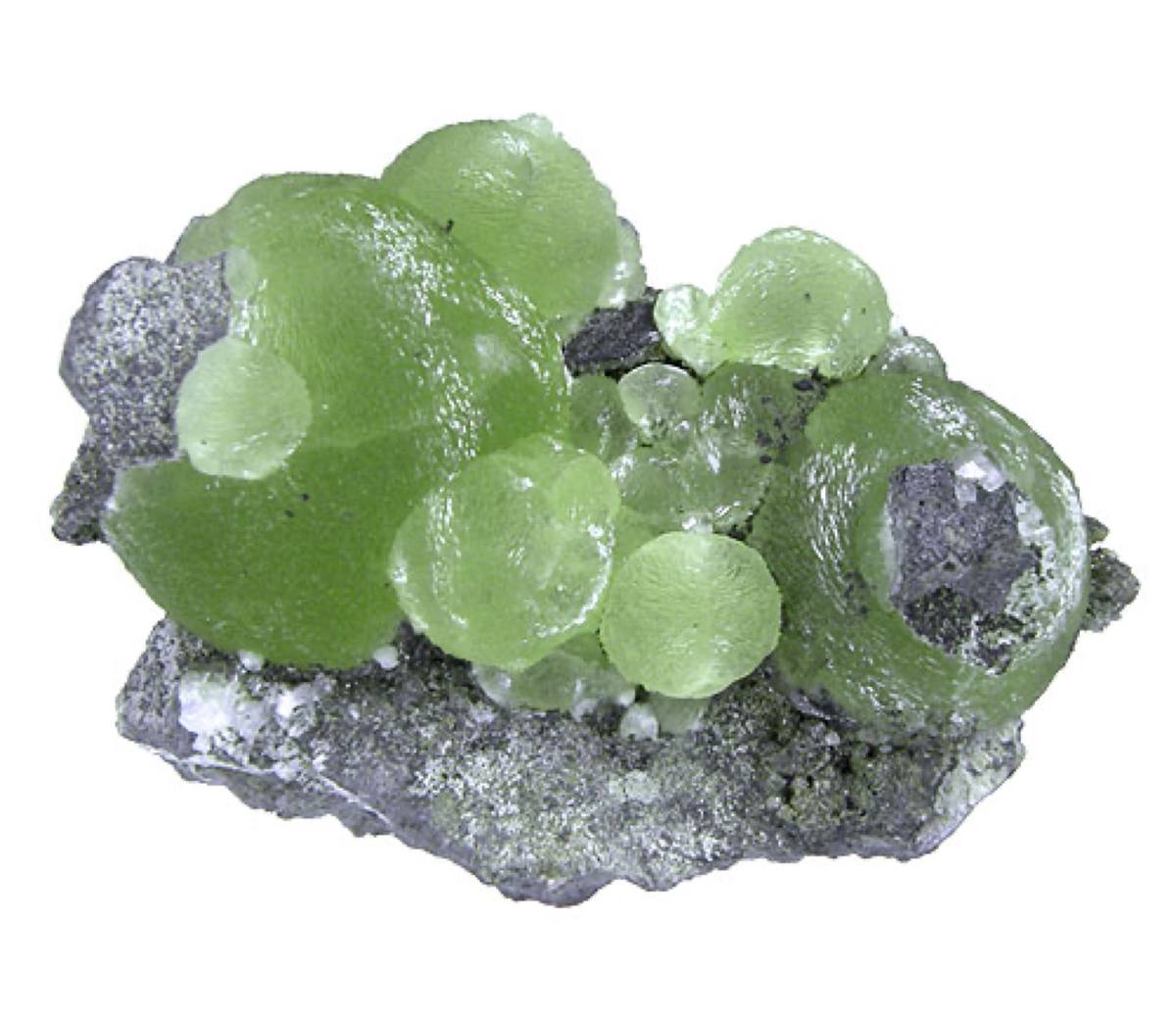
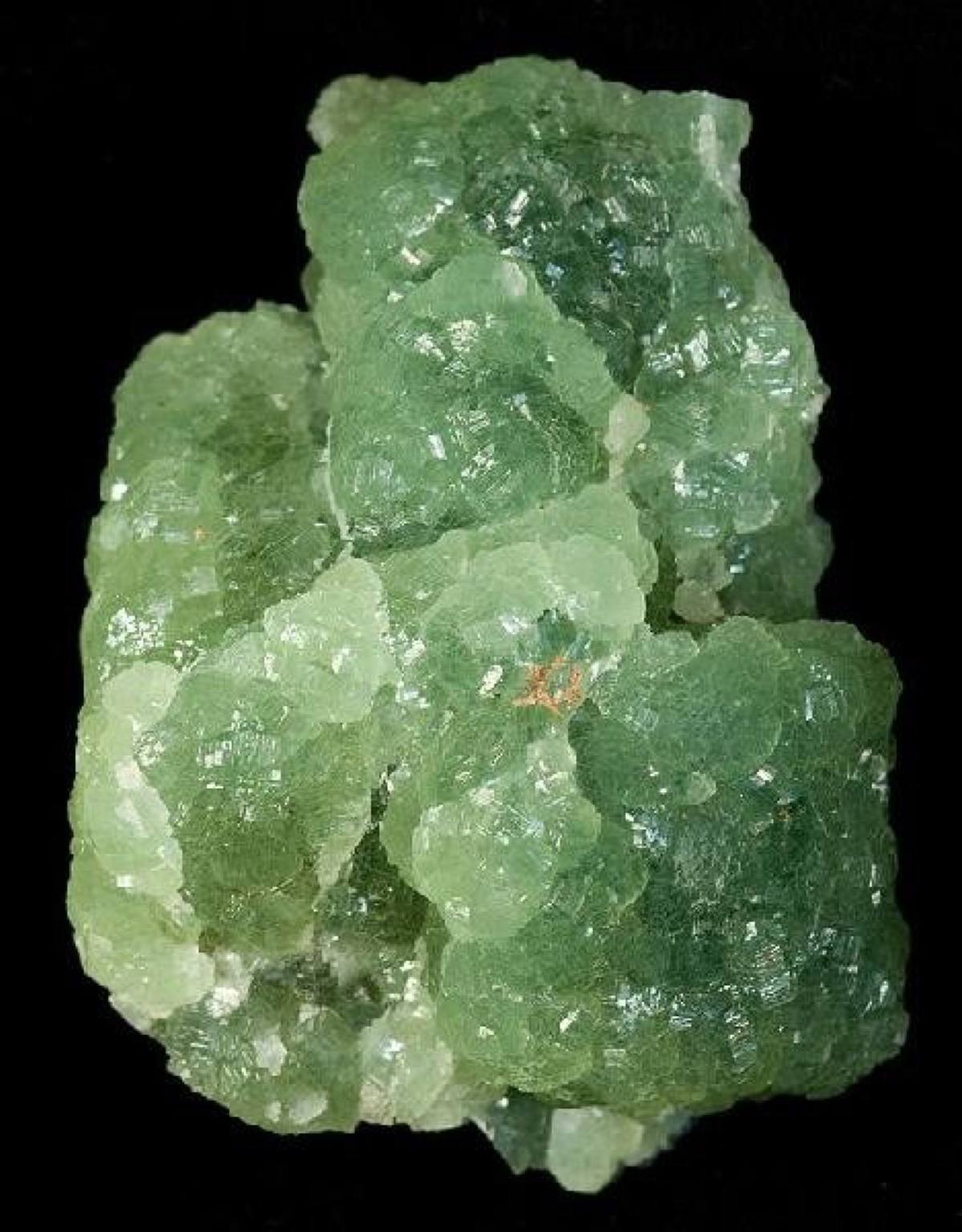
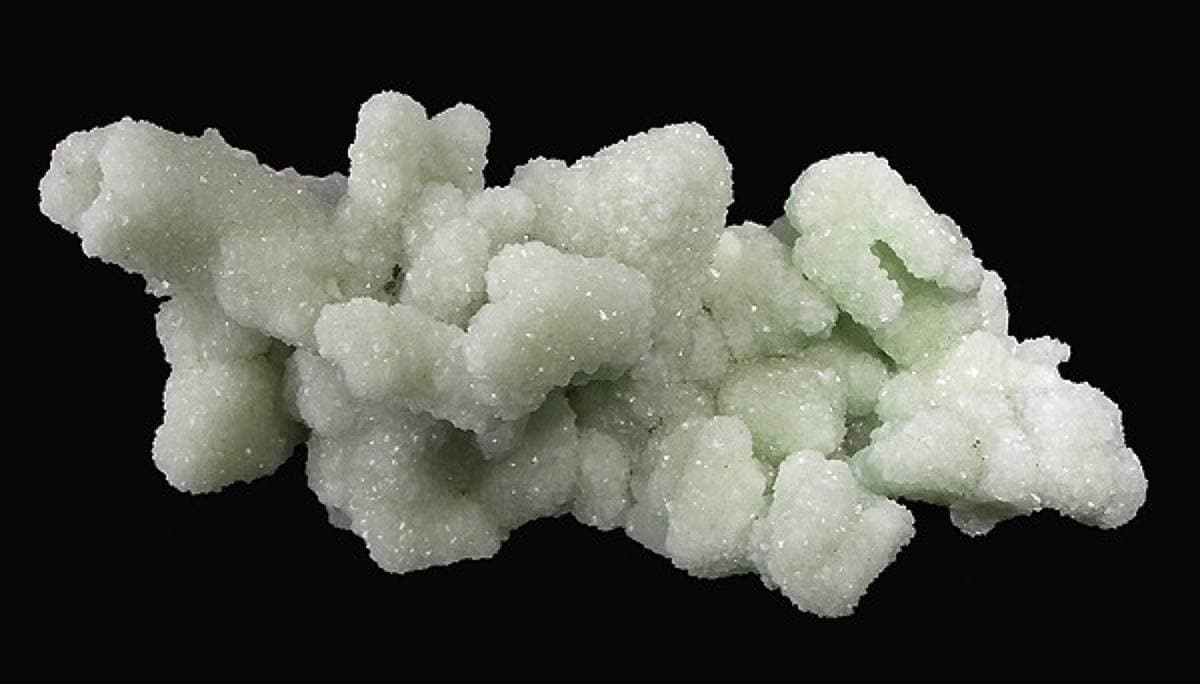
Prehnite is best recognized by its characteristic apple-green color and distinct botryoidal or globular habit. It is commonly found as a secondary mineral in the vesicles and cavities of mafic volcanic rocks and is a popular choice for cabochons due to its attractive luster and durability.
Spotting prehnite in the field
Field marks- 1
Pale green to yellow-green, translucent, with a distinctive grape-cluster botryoidal surface
- 2
Interior shows a radiating fibrous structure
- 3
Hardness 6 to 6.5, with a slightly waxy to pearly luster
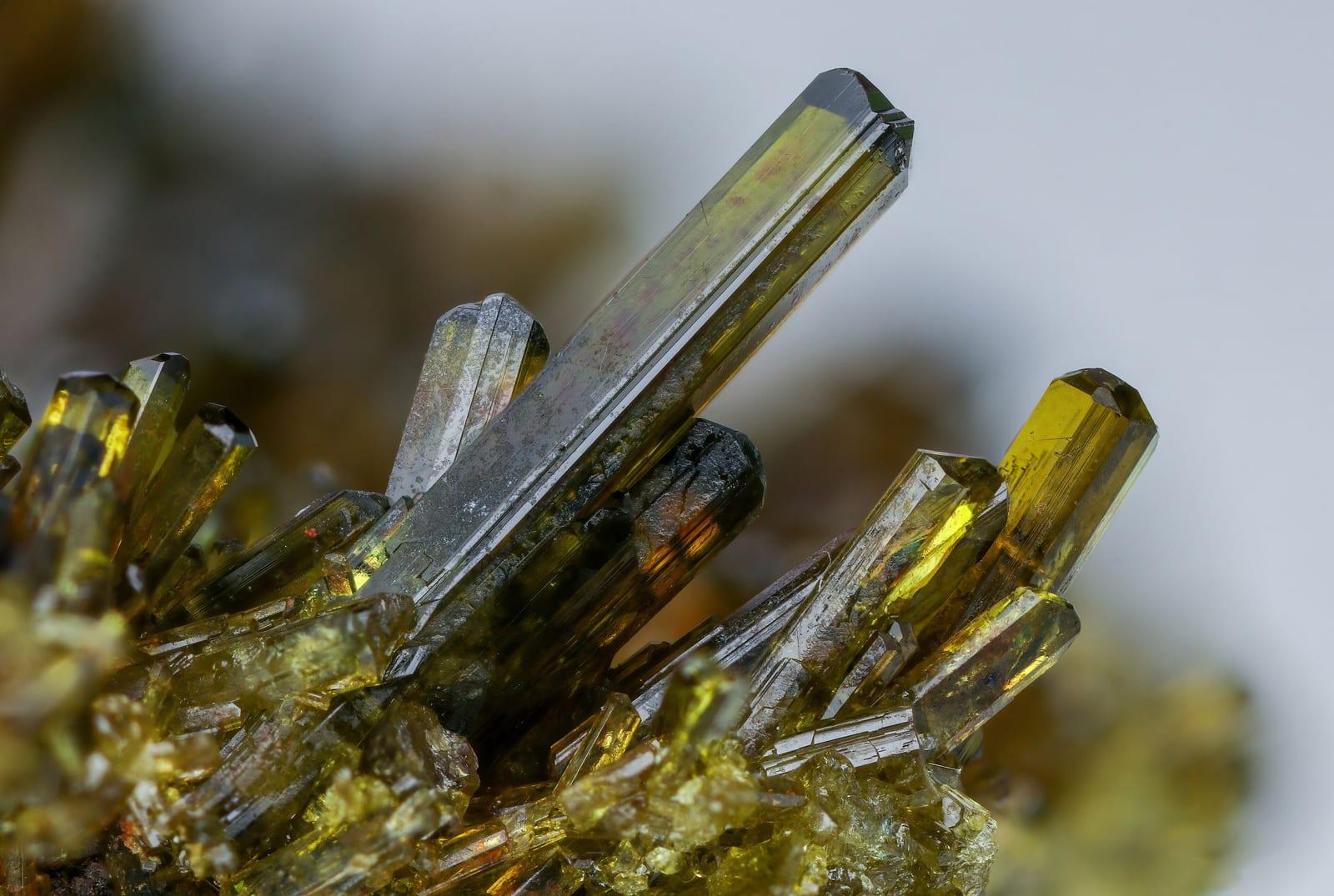
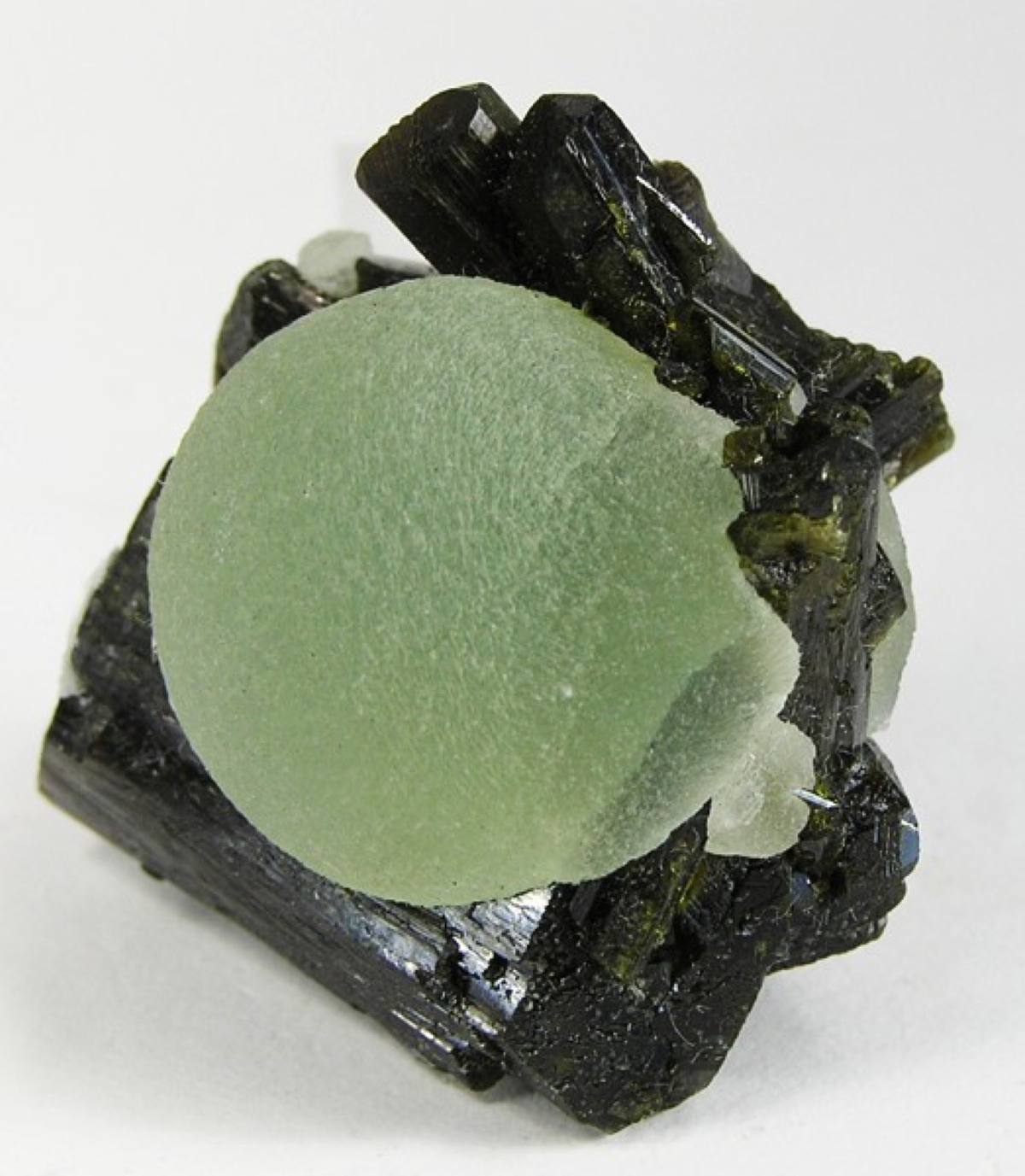
Prehnite fills cavities in basalt and other volcanic rock, so the places to look are traprock quarries and lava flows. The New Jersey traprock quarries around Paterson are the classic American locality, alongside the Keweenaw in Michigan and the Bay of Fundy basalts in Nova Scotia. The botryoidal grape-cluster surface with a radiating interior is very distinctive, and prehnite frequently hosts fine needles of black epidote, which collectors specifically want.
Straight answers
- Is it worth cutting?
- Cabs well and its slightly cloudy translucence suits a high dome. Specimens with black epidote needles inside are worth cutting to display the needles.
- What is it really worth?
- Inexpensive. Translucent even green material, and pieces with sharp epidote inclusions, carry the premium.
- Can you legally keep it?
- Active traprock quarries are private and generally allow collecting only through organized club visits, which is the practical route in New Jersey.
Often confused with
Prehnite vs. its common look-alikes, and how to tell them apart in the field.
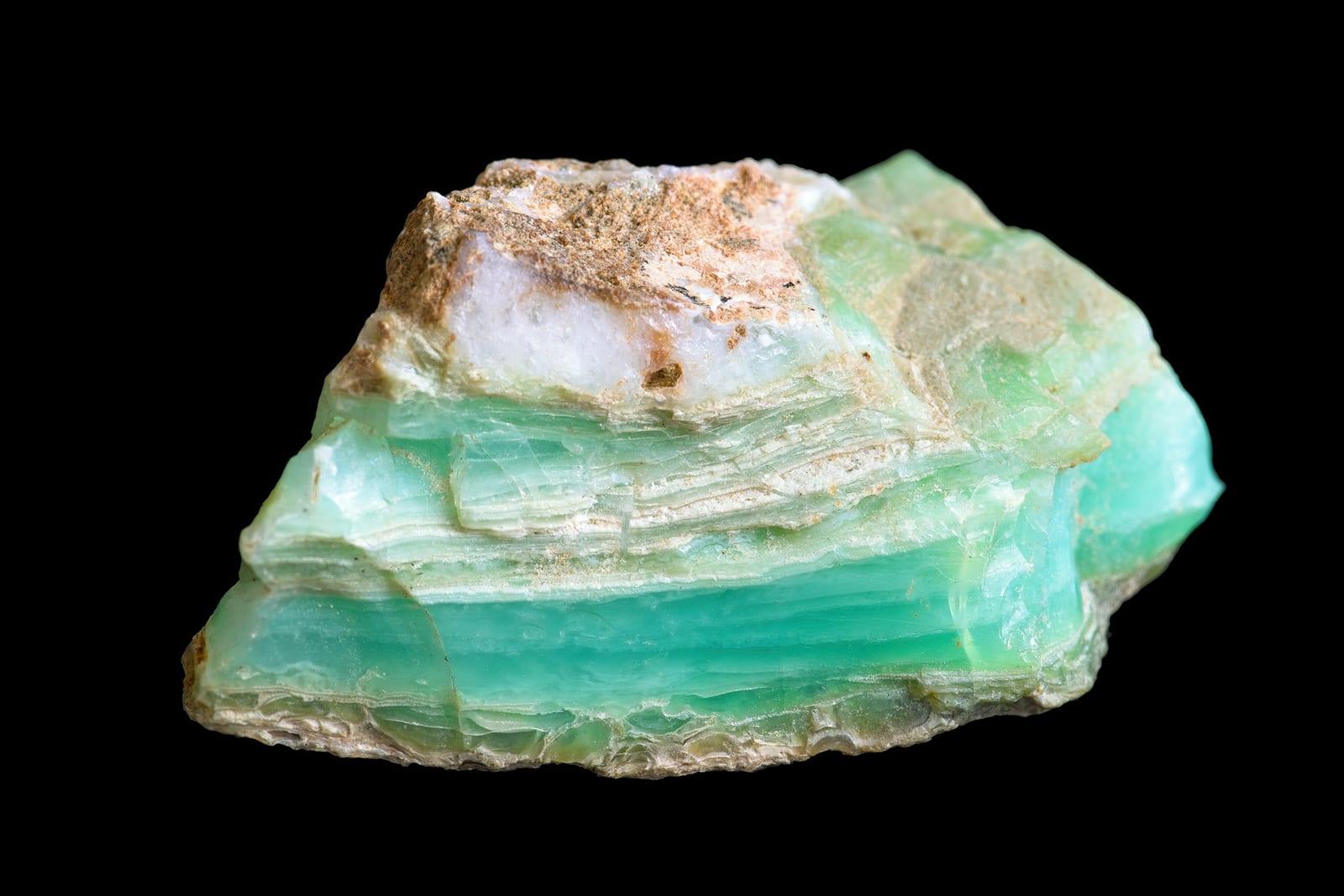
How to tell apart: Chrysoprase is chalcedony at hardness 7 with conchoidal fracture. Prehnite is softer and shows a radiating fibrous interior.
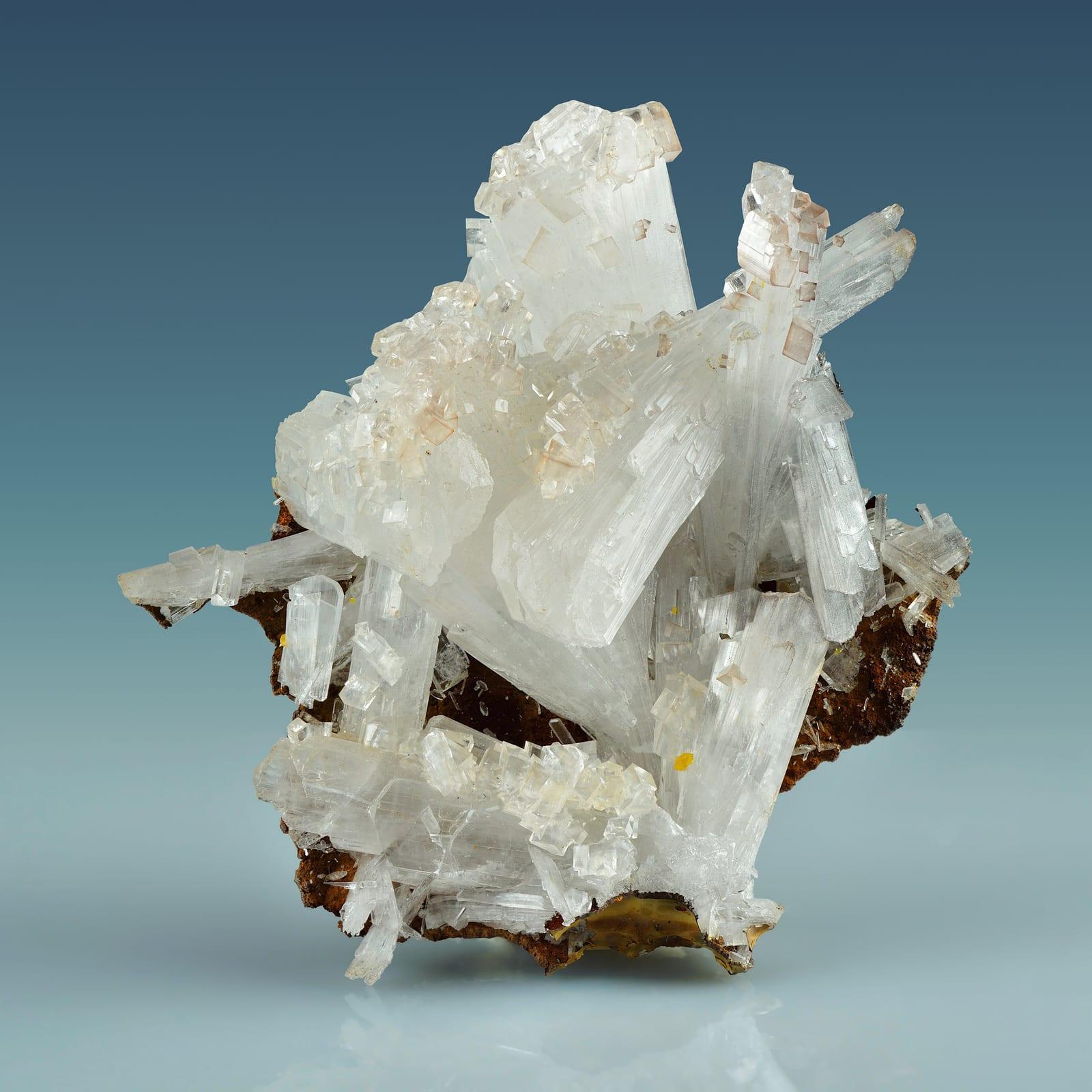
How to tell apart: Also botryoidal, but usually blue-white rather than green, and softer at 4.5 to 5.
Often found alongside prehnite
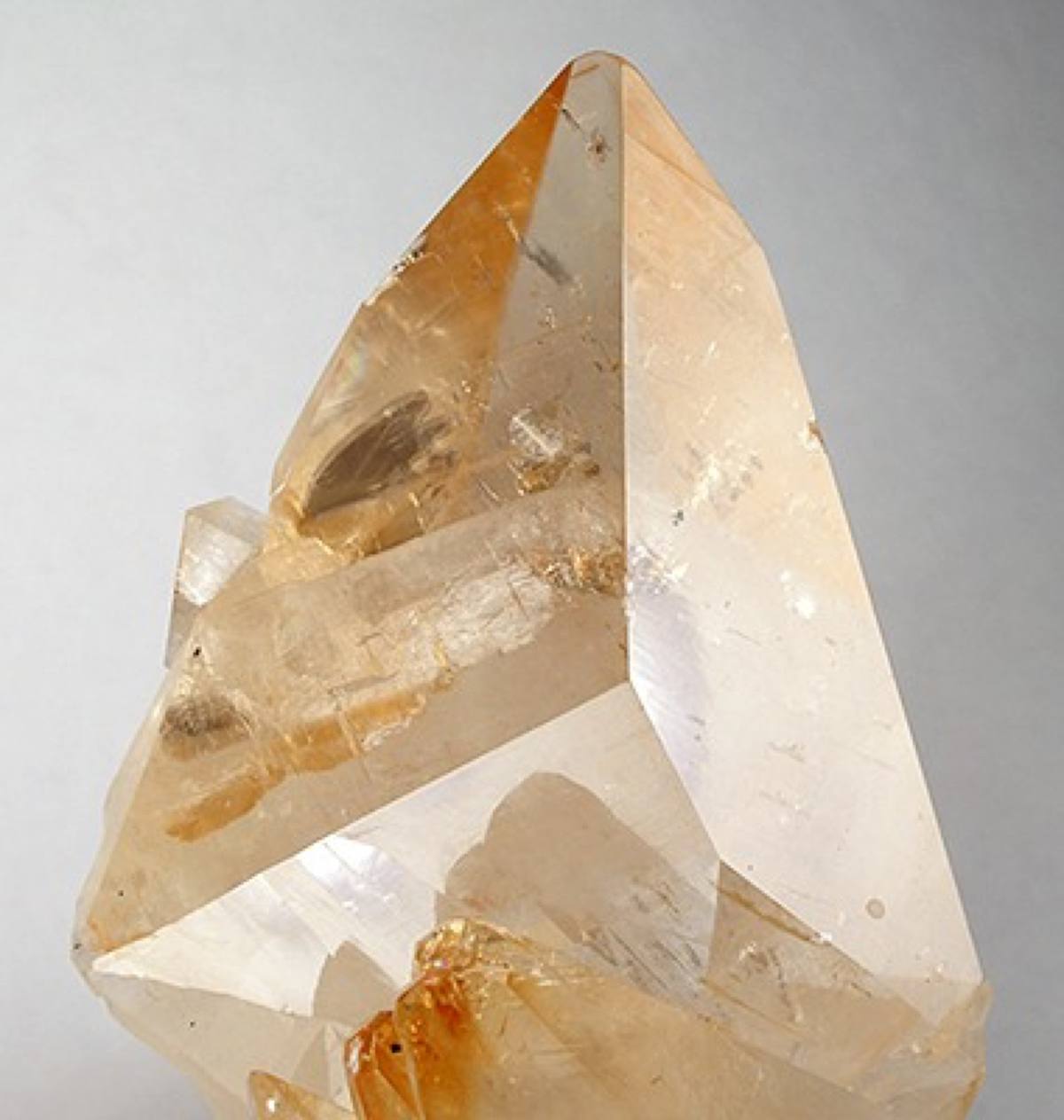
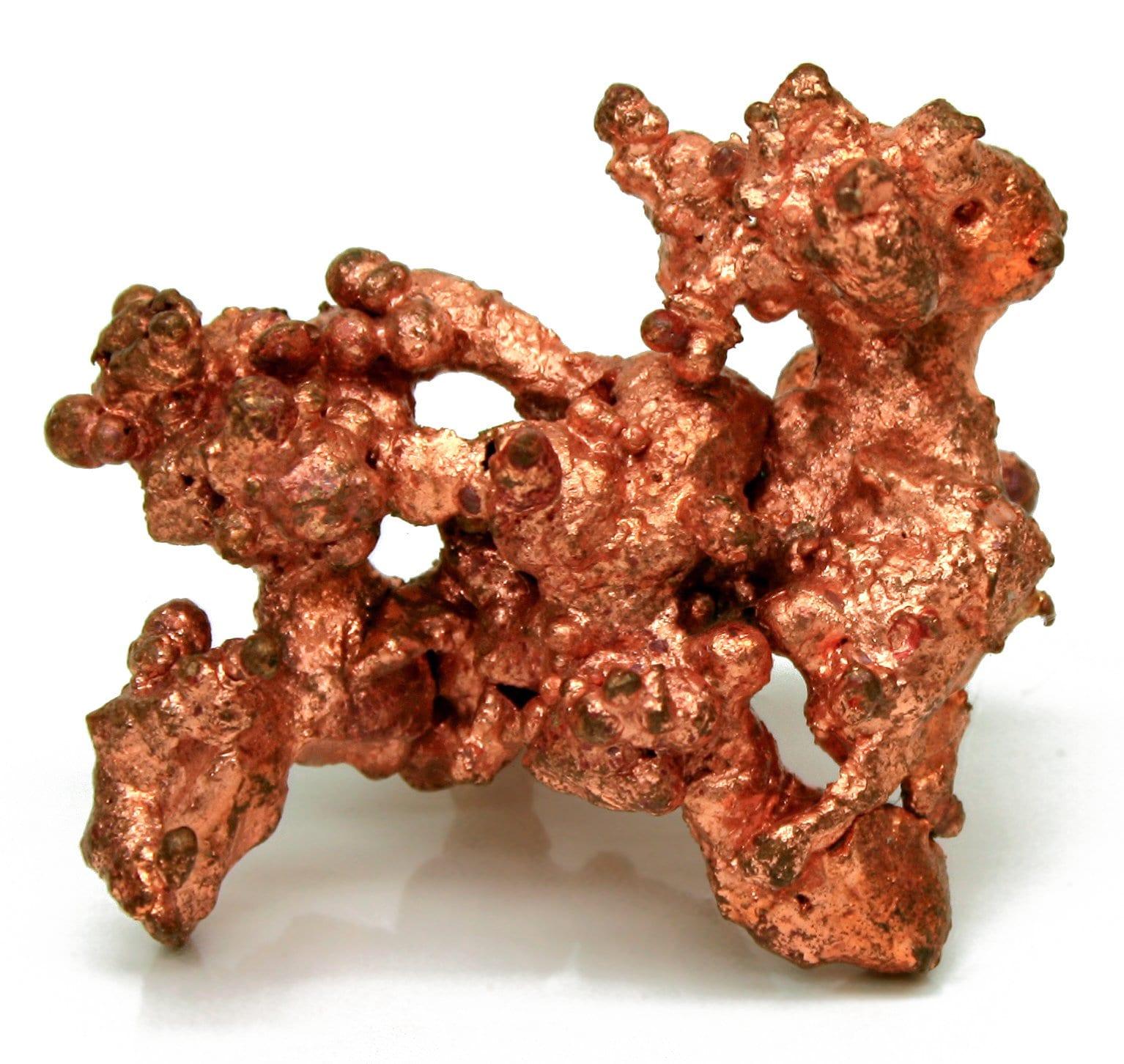
Minerals reported to co-occur with prehnite. Spotting these in float or country rock is a strong cue you are in the right ground.
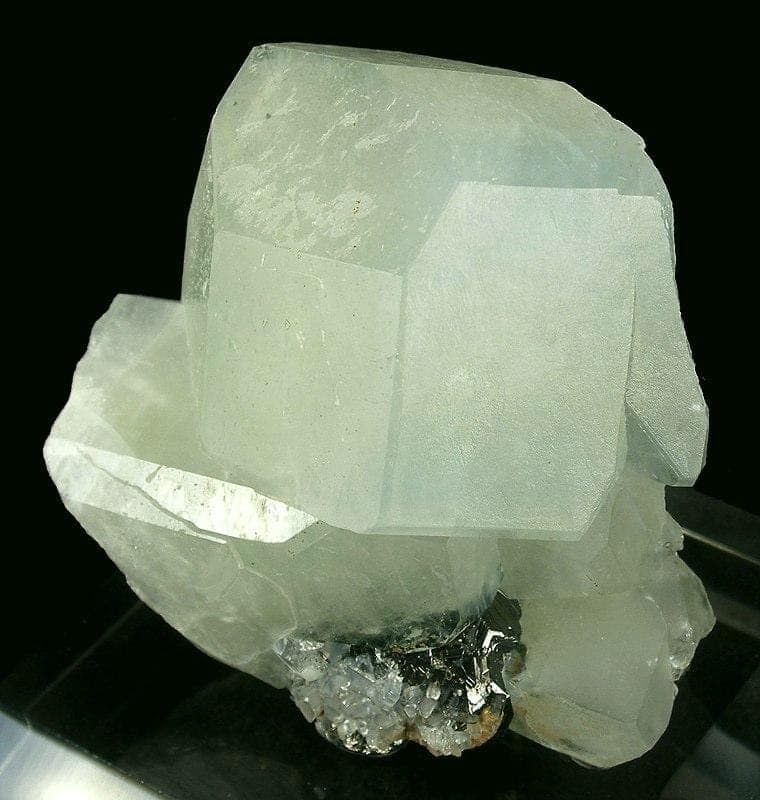
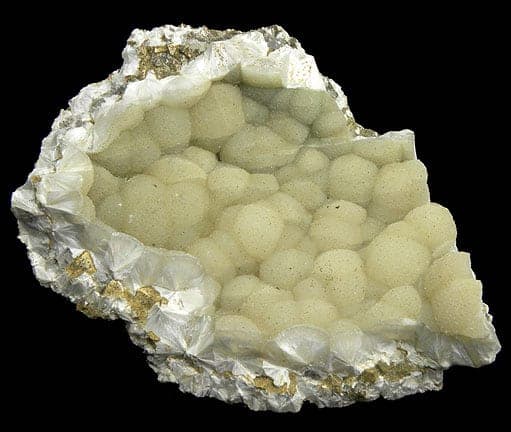
All properties
- Chemical formula
- Ca₂Al₂Si₃O₁₀(OH)₂
- Mohs hardness
- 6-6.5
- Density
- 2.8-2.95 g/cm³
- Streak
- White
- Luster
- Vitreous, weak pearly on {001}
- Transparency
- Semitransparent to translucent
- Crystal system
- Orthorhombic
- Crystal habit
- Botryoidal, globular, reniform, or tabular crystals
- Cleavage
- Good on {001}, poor on {110}
- Fluorescence
- Blue white mild peach under SW UV; yellow under LW UV
- Rarity
- Common
- Uses
- Collector, Lapidary, Ornamental
- Host rock
- A secondary or hydrothermal mineral in veins and cavities in mafic volcanic rocks; less commonly in granite gneiss or syenite; a typical product of low-grade metamorphism
Where rockhounds find prehnite
34 mapped spotsClassic worldwide localities
- Paterson, Passaic Co., and Bergen Hill, Hudson Co., New Jersey, USA
- Fairfax quarry, Centreville, Fairfax Co., Virginia, USA
- Roncari quarry, East Granby, Hartford Co., Connecticut, USA
- Hampden quarry, West Springfield, Hampden Co., Massachusetts, USA
- Cape of Good Hope, Cape Province, South Africa
- Copper Valley, Brandberg Mountains, Namibia
U.S. states with prehnite
Each link opens a state-specific list of mapped rockhounding spots that produce prehnite.
Field-hunting tip
Where it forms: A secondary or hydrothermal mineral in veins and cavities in mafic volcanic rocks; less commonly in granite gneiss or syenite; a typical product of low-grade metamorphism. If you start seeing zeolites, datolite, pectolite in float, you are in the right ground. Typical habit: botryoidal, globular, reniform, or tabular crystals. Train your eye for that shape before scanning the outcrop. In the U.S., the densest reported localities are in Michigan, New Jersey, Connecticut. Start trip planning there.
More prehnite photos
Common questions
How do you identify prehnite?+
Where is prehnite found?+
Can I find prehnite in the United States?+
What rocks look like prehnite?+
What minerals are found with prehnite?+
What kind of rock does prehnite form in?+
What is prehnite used for?+
Find prehnite on the map
RockHoundR shows mapped rockhounding spots, access rules, and lets you log every find.